1893-1918


1918-1940


1940-1960

  1960s   1970s   1980s   1990s   2000s   All Years   By Match   Shirts/logos    Badges

HOME   Contact   Programmes   For Sale & Wanted   Wallpapers   Guestbook   League History   Club History   Flags

 Club History

The history below is taken directly from the Oxford United entry on wikipedia at http://en.wikipedia.org/wiki/Oxford_United_F.C.

 
Oxford United F.C. are an English football team who are playing in the Conference National for the 2006-07 season.

The club is owned by chairman Nick Merry and managed by Jim Smith. Its home ground is the Kassam Stadium in Oxford with a capacity of 12,500.

Its history is quite unlike that of any other club in English football. In the space of less than half a century, it has joined the Football League, climbed from the Fourth Division to the First in 20 years, won the League Cup, and endured an 18-year decline which saw it relegated to the Conference—making it the first team to have won a major trophy to endure this disappointment.

Current manager Jim Smith (also a director) has recently returned to the club some 20 years after his first spell in charge. He was the man who took Oxford into the top flight, and he is now the man who will be expected to restore Oxford to the Football League.

Other well-known men to have managed Oxford United include Brian Horton, Mark Lawrenson, Maurice Evans, Denis Smith, Ian Atkins and Brian Talbot. Well-known players to have worn an Oxford shirt include Ron Atkinson, Ray Houghton, Dean Saunders and John Aldridge.

History of the Club

Headington United

Oxford United was formed as amateur club Headington in 1893, adding the suffix United the following year, and competed in local leagues until being elected to the Southern League and becoming professional in 1949. In 1960, Headington United was renamed Oxford United in order to give it a higher profile.

Promotion to the League

Two years later, in 1962, the club won the Southern League title for the second successive season and was elected to the Football League Fourth Division, occupying the vacant place left by bankrupt Accrington Stanley. Two successive 18th place finishes followed, before promotion to the Third Division was achieved in 1965. In 1964, they had become the first Fourth Division club to reach the Quarter Final of the FA Cup, and have not progressed that far in the competition since then. Oxford won the Third Division title in 1967–68, their sixth season as a league club, but after eight years of relative stability the club was relegated from the Second Division in 1975/76.

The Robert Maxwell takeover

In 1982, while a Third Division side, Oxford United was taken over by controversial business tycoon Robert Maxwell (1923–1991). Maxwell proposed to merge United with neighbours Reading to form a single club called the Thames Valley Royals, to play at Didcot. The merger was called off after fans of both clubs protested against the decision.

Oxford won the Third Division title in 1984 under the management of Jim Smith, who also guided them to the Second Division title the following year. This meant that Oxford United would be playing First Division football in the 1985–86 season, 23 years after joining the Football League. Smith moved to Queens Park Rangers shortly after the promotion success, and made way for chief scout Maurice Evans, who several seasons earlier had won the Fourth Division title with Reading.

Oxford at the top

Oxford United finished 18th in the 1985–86 First Division campaign, avoiding relegation on the last day of the season, but most impressively winning the Milk Cup with a 3–0 win over Queens Park Rangers at Wembley. They would have qualified for the UEFA Cup the following season had it not been for the ban on English teams that had arisen from the previous year's Heysel Stadium disaster. It was an excellent way for Oxford to begin life as a top-division side, although they never really competed with the best.

1986-87 saw another relegation battle which was narrowly won. Robert Maxwell resigned as Chairman in May 1987 to take over at Derby, handing the club to his son Kevin. Maurice Evans was sacked in March 1988 with Oxford bottom of the First Division and destined for relegation after three years in the top flight.

Life in the second tier

Before relegation was confirmed, former Liverpool defender Mark Lawrenson was named as Oxford's new manager, but he was sacked three months into the 1988–89 Second Division campaign after a dispute with the chairman over the £1 million sale of striker Dean Saunders to Derby County, owned by Kevin Maxwell's father Robert Maxwell. Brian Horton was named as Oxford's new manager, and remained in charge until September 1993 when he was lured away to Manchester City in the recently-formed FA Premier League. Oxford, now a side in the new Football League Division One, briefly restored Maurice Evans to the manager's seat before turning to Bristol City manager Denis Smith. By now, Oxford were deep in relegation trouble. Despite Smith's efforts, Oxford slid into Division Two at the end of the 1993–94 season.

The Manor in 1964, packed with Oxford's record attendance
 of 22,750 for the FA Cup match v Preston North End
The London Road End

Promotion success in Division Two

Denis Smith set about restoring Oxford United to the upper tier of the English league, and brought in two strikers who were experienced in the top division — Southampton's Paul Moody and Nottingham Forest's Nigel Jemson. Oxford finished mid-table in 1994–95, after heading the table at Christmas, but finished runners-up to near neighbours Swindon Town in 1995–96 and regained their place in Division One. A good start to the 1996–97 season saw Oxford looking hopeful of gaining promotion to the Premiership, but the squad lacked the strength to make this form consistent and they wallowed away to finish 17th, following the sale of star defender Matt Elliott. Despite Smith's departure to West Bromwich Albion in December 1997, United finished a reasonable 11th in the 1997–98 final table of Division One under his successor Malcolm Shotton — who had been assistant manager of the Barnsley side which had recently gained promotion to the Premiership. Shotton had also been Oxford's captain during the glory years of the mid-1980s.

Shotton was unable to motivate his team successfully in 1998–99, and they were relegated in last-but-one place.

Financial crisis

In June 1995, Oxford United's board of directors had unveiled plans for a new 16,000-seat stadium at Minchery Farm to replace the dilapidated Manor Ground. The club had hoped to move into the new stadium near the Blackbird Leys housing estate by the start of the 1998–99 season, but construction was suspended during the 1997–98 season because of £13 million debts, which almost bankrupted the club.

During October and November 1998 the backroom staff at the club went unpaid, due to United's financial situation, and supporters rallied round, delivering food parcels to the ground. Supporters set up a pressure group called FOUL (Fighting for Oxford United's Life), which began to publicise the club's plight through a series of meetings and events. Chairman Robin Herd had effectively given up on the club, and in April 1999 Firoz Kassam bought Herd's 89.9% controlling interest in Oxford United for £1, with which he also inherited the club's estimated £15 million debt. Kassam reduced £9 million of the debt to £900,000 by virtue of a CVA, by which unsecured creditors who were owed over £1,000 were reimbursed with 10p for every pound they were owed. Secured creditors were paid off when Kassam sold the Manor to another of his Firoka companies for £6,000,000.  Kassam set about completing the unfinished stadium, gaining planning permission for a bowling alley, a multiplex cinema, and a hotel, among other things, following a series of legal battles which were eventually all settled.

The Manor - in the late 90s The Kassam Stadium - not long after completion (well almost!)

Another relegation

Oxford's poor form continued into the 1999–2000 season, forcing Shotton to resign in late October with the club deep in relegation trouble. Mickey Lewis was appointed player-manager, but didn't manage a significant improvement during his four months in charge. Finally, Denis Smith returned to the club and under his management Oxford rallied and finished 20th in the Division Two final table — one place clear of relegation. Smith was sacked after a terrible start to the 2000–01 campaign, and his successor David Kemp was unable to stop the club's fortunes from declining even further. Kemp was sacked at the end of the season, when Oxford were relegated back to the basement division of the league after a 35-year absence, with 100 goals conceded. They suffered 33 league defeats — the second highest number of league defeats ever endured by a league club.

Life in the basement division

Oxford began the 2001–02 season with a new stadium and a new manager. They finally completed their relocation to the Kassam Stadium, named after new owner Firoz Kassam, after six years of speculation. Former Liverpool and England defender Mark Wright was given the manager's job, but resigned in late November after being accused of making racist remarks to referee Joe Ross. Wright's successor Ian Atkins was unable to make much of a difference and Oxford finished the Division Three campaign in 21st place — their lowest-ever league position, although there was never any real threat of them losing their league status.

Oxford did better in 2002–03, spending most of the season in either the automatic promotion or playoff places. But defeat in their final game of the season meant an eighth-place finish, not even enough for a playoff place.

An excellent start to the 2003–04 season suggested that Oxford's three-year spell in Division Three might soon be over. But manager Ian Atkins was sacked in March after agreeing to take charge at rivals Bristol Rovers, and under his successor Graham Rix the club plummeted to ninth place in the final table. Rix was sacked the following November, with Oxford in the bottom half of Coca-Cola League Two. Oxford replaced him with the Argentine Ramón Díaz, who was unable to secure anything higher than a mid-table finish. Diaz and his team of assistants left the club at the beginning of May 2005 and ex-England midfielder and former West Bromwich Albion, Rushden and Oldham manager Brian Talbot was immediately signed on a two-year contract as replacement. Apart from a brief winning streak in September which saw United reach 8th in the table, Talbot found little success and was sacked in March 2006 with the club in 22nd place. He was replaced by youth team coach Darren Patterson.

On 21 March 2006, Firoz Kassam sold the club for approximately £2 million (including the club's debts) to Florida-based businessman Nick Merry, who had played for United's youth team in the mid-1970s. Merry immediately initiated changes to the upper hierarchy of the club. Jim Smith, the club's most successful ever manager, returned to the helm bringing in five new players on his first day in charge.

Relegation from the Football League

Smith was unable to prevent relegation. After 44 successive years in English league football, a 2–3 home defeat to Leyton Orient on 6th May 2006 saw Oxford relegated from League Two in 23rd place (with Rushden, who finished bottom). The same result earned Leyton Orient promotion to League One. By coincidence, one of the sides to be promoted to the League at the same time were Accrington Stanley, the side Oxford replaced when they were elected to the League in 1962.
 

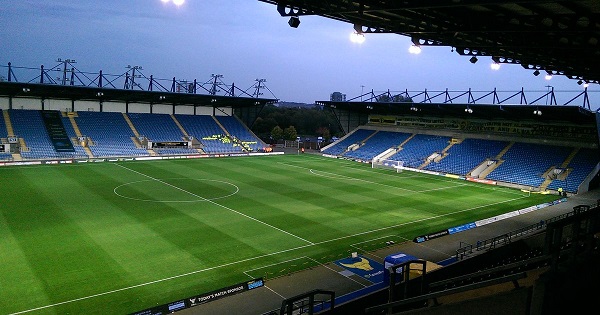
The East & South Stands, taken from the North Stand - 16 Feb 2008 (photo © of Carl Flaherty www.bloods.fotopic.net/ )

2006-08: Conference National

Jim Smith was retained as manager for 2006–07. The season started brightly for Oxford, with 14 wins and 8 draws from their opening 25 games—including a run of 18 games before their first defeat, a Conference record for an unbeaten run at the start of a season—giving the club a 9-point lead at the top of the table at one stage in early October. However, this was followed by a run of eleven league games without a win from November, which saw them drop into second place just after Christmas, in which position they remained until the end of the season. On Boxing Day 2006 a crowd of 11,065 watched United draw 0–0 with Woking at the Kassam Stadium, the largest-ever attendance for a Football Conference match (excluding playoffs). Their automatic promotion hopes were finished on 7 April 2007 when Dagenham and Redbridge clinched the Conference National title, though they qualified for the playoffs by coming second, facing Exeter in the playoff semi-finals. After winning 1-0 in the first leg at Exeter, Oxford lost the second leg 2-1 and after extra time lost 4-3 on penalties, thus failing in their attempt to return to the Football League at the first attempt. Therefore Oxford will be playing in the re-named Blue Square Premier League (formerly Conference National) for the 2007-08 Season.


Top  Home

1893-1918


1918-1940


1940-1960

  1960s   1970s   1980s   1990s   2000s   All Years   By Match   Shirts/logos    Badges

Site is copyright © of www.oxkits.co.uk
To add information, photographs or detail of any aspect of OxKits please contact here
All home kit graphics icons are used with the permission of www.historicalkits.co.uk which should be visited for up to date material, and those of other British clubs.